Last week, researchers with grants from the Agency for Healthcare Research and Quality (AHRQ) received letters informing them that their grants have ended. The letters use the absurdist language of a “notice of non-award,” to inform them that the grants will not receive the standard annual renewal expected of any such research awards. This is merely terminations in a different set of clothes, and the latest step in the administration dismantling AHRQ as part of its continued assault on health equity and the rule of law.
Grant Witness has collected data so far 150 of those terminated AHRQ grants, now in our public database, and are continuing to track AHRQ’s actions. Here we summarize what we know so far about the terminations, and the broader context of AHRQ’s collapse.
Important
Has your AHRQ grant been terminated, delayed, or received a “notice of non-award”? Please report it to us!
These grants had been all but terminated by AHRQ’s failure to issue renewals
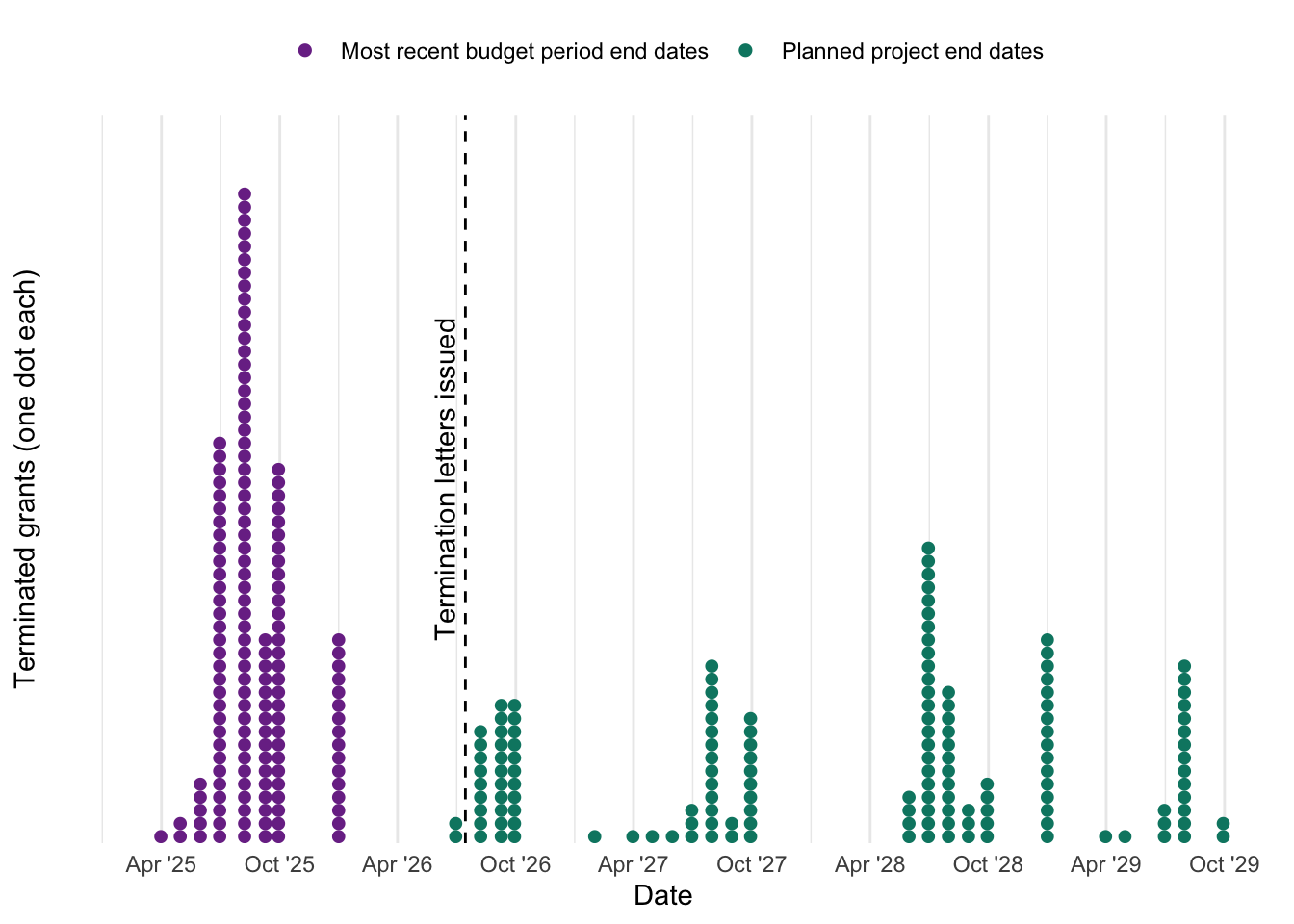
Since the start of 2025, activity at AHRQ has ground to a halt. AHRQ has only issued 263 routine non-competing renewals of existing awards since the start of 2025, leaving a large share of its portfolio in limbo as their annual budgets ran out. Of the 150 awards that received termination letters, all had been waiting for renewal for six to fifteen months, though the projects were scheduled to end between June 2026 and September 2029.
Figure 1 shows the end of the terminated awards’ most recent funded budget periods, and original scheduled project end dates, as compared to last week’s termination. Years of future research have been cut off.
In addition to these 150 terminated grants, an additional 32 have been waiting for more than two months to be renewed. Some have been waiting as much as 7 months.
These terminations continue the gutting of AHRQ’s portfolio
Of 349 AHRQ grants that we have tracked as active since the start of the Trump administration, now 182 (52%) have either been terminated outright or are 60+ days overdue for renewal with no word either way. That share is compounded by a near-total collapse in new funding1: AHRQ made only 7 new awards in all of FY2025 — worth $3.40 million — down from 393 in FY2024 and hundreds per year in prior years. So far in FY2026, AHRQ has made zero new awards. AHRQ’s research portfolio isn’t just being cut, it has also nearly stopped being replenished.
| Total AHRQ awards issued each fiscal year | ||||
| Fiscal Year | New/Competing Awards | Non-Competing Awards | Total Awards | Total $ (millions) |
|---|---|---|---|---|
| FY2021 | 153 | 407 | 550 | $198.60 |
| FY2022 | 309 | 436 | 728 | $286.10 |
| FY2023 | 416 | 549 | 875 | $334.60 |
| FY2024 | 393 | 761 | 1,131 | $410.90 |
| FY2025 | 7 | 588 | 591 | $217.50 |
| FY2026 (through Jul 21) | 0 | 36 | 36 | $15.60 |
None of the collapse reflects a comparable cut from Congress. AHRQ’s enacted appropriations have been essentially flat through FY20262:
| AHRQ enacted appropriations, FY2023-FY2026 | |||
| Source: Congressional Research Service, Report R44136 | |||
| Fiscal Year | Discretionary Appropriation | ACA Funds | Total Program Level |
|---|---|---|---|
| 2023 | $374,000,000 | $111,000,000 | $485,000,000 |
| 2024 | $369,000,000 | $118,000,000 | $487,000,000 |
| 2025 | $369,000,000 | $127,000,000 | $496,000,000 |
| 2026 | $345,000,000 | $134,000,000 | $479,000,000 |
This collapse of grantmaking is the subject of ongoing litigation in Society of General Internal Medicine v. Kennedy.
With such a large fraction of AHRQ’s portfolio disrupted, we can see the breadth of fields and institutions affected. The cuts skew heavily toward schools of medicine and independent hospitals — together they bear well over half of all AHRQ terminations:
| Terminated and delayed AHRQ grants by recipient organization type | ||
| Organization Type | Terminated | Delayed (not yet terminated) |
|---|---|---|
| Schools Of Medicine | 71 | 15 |
| Independent Hospitals | 28 | 7 |
| Schools Of Public Health | 13 | 2 |
| Research Institutes | 11 | 1 |
| Schools Of Nursing | 8 | 1 |
| Other Domestic Non-Profits | 5 | 1 |
| University-Wide | 5 | 2 |
| Sch Allied Health Professions | 2 | 1 |
| Schools Of Dentistry/Oral Hygn | 2 | 0 |
| Schools Of Pharmacy | 2 | 1 |
| Biomed Engr/Col Engr/Engr Sta | 1 | 0 |
| Graduate Schools | 1 | 0 |
| Schools Of Social Welfare/Work | 1 | 0 |
| Organized Research Units | 0 | 1 |
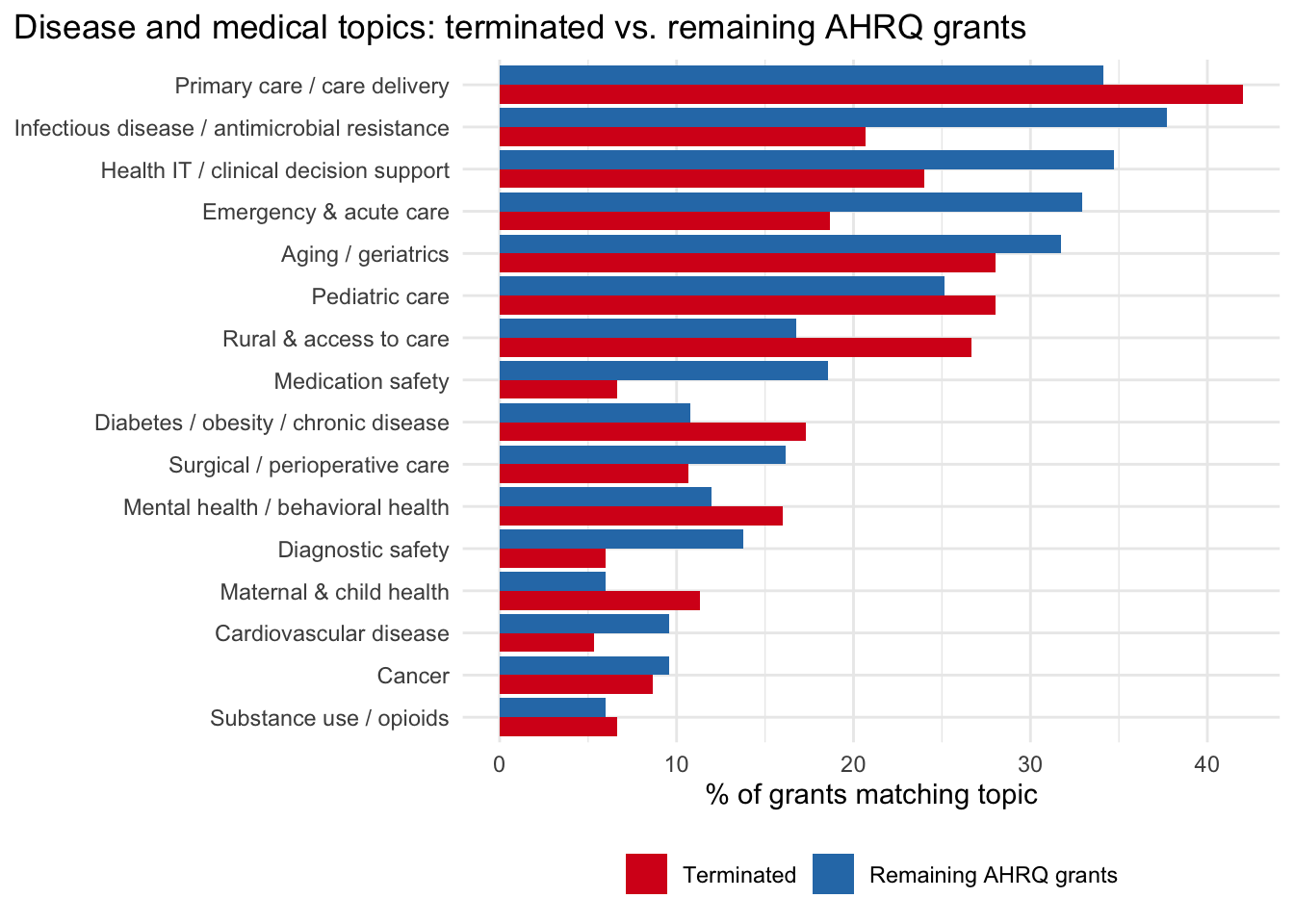
The broad areas of research in these terminated grants3 constitute the core challenges to American health care today: Primary care and care-delivery research is the single largest topic among terminated grants, followed by pediatric care, aging/geriatrics, and rural/access-to-care research. Comparing rates to rest of the AHRQ portfolio, rural/access-to-care research and primary care/care delivery are the most overrepresented topics among terminations (both roughly 9-10 points higher than their rate in remaining grants), followed by diabetes/chronic disease, maternal & child health, and mental health.
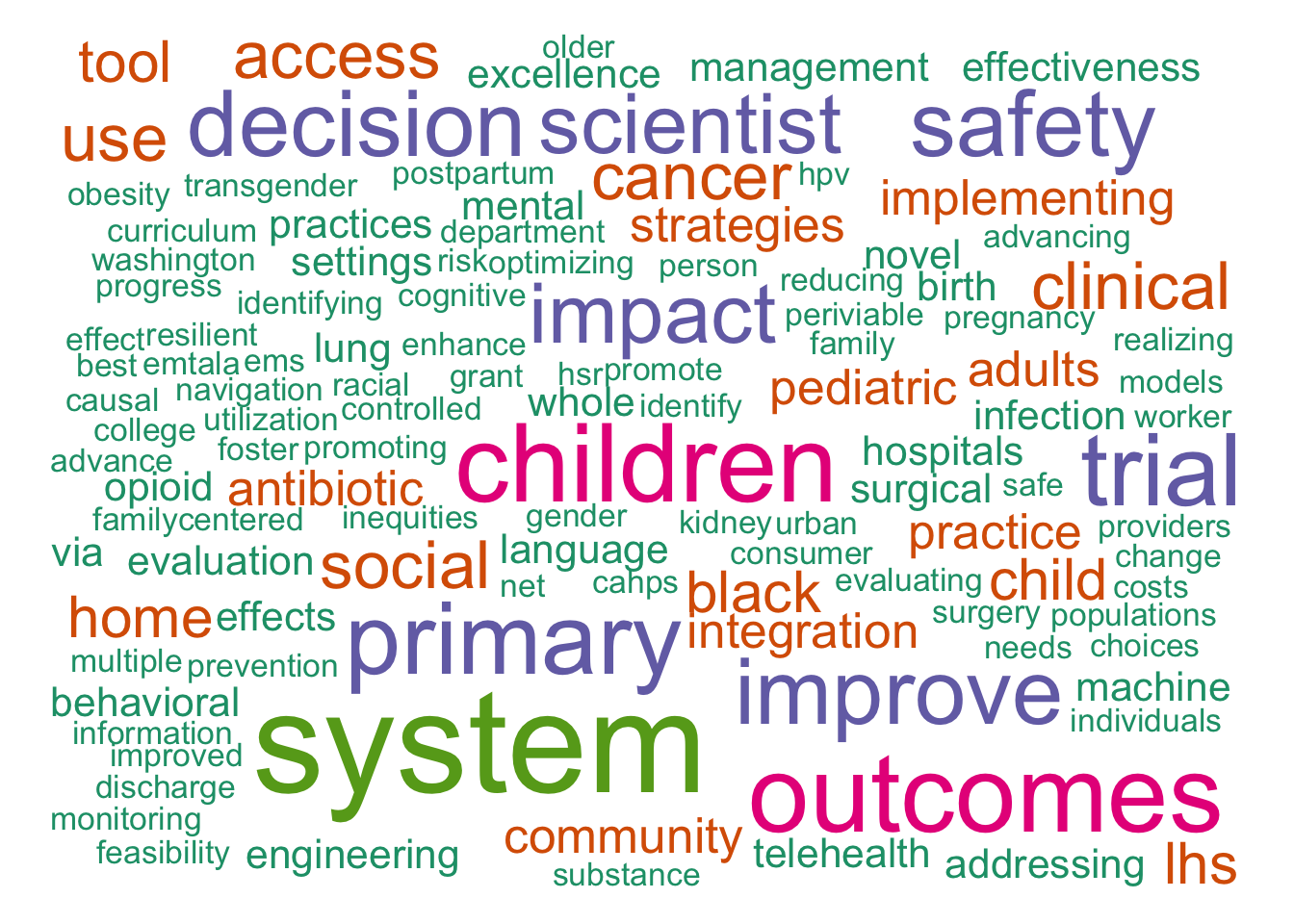
We can also visualize the subjects of these grants with a wordcloud of the most common words in their titles and abstracts.
The administration’s war on health equity and underserved populations continues
In AHRQ’s 1999 authorizing legislation4, Congress gave it an explicit mandate to fund research on health care disparities. From the start Congress specifically directed the agency to address the needs of low-income groups, minorities, women, children, the elderly, and people with special health care needs (via a statutorily required “Office of Priority Populations”), and to produce recurring national reports on health care quality and disparities.
Nonetheless, as in many of their actions over the past 18 months, the administration has swung their axe squarely at health disparities research at AHRQ.
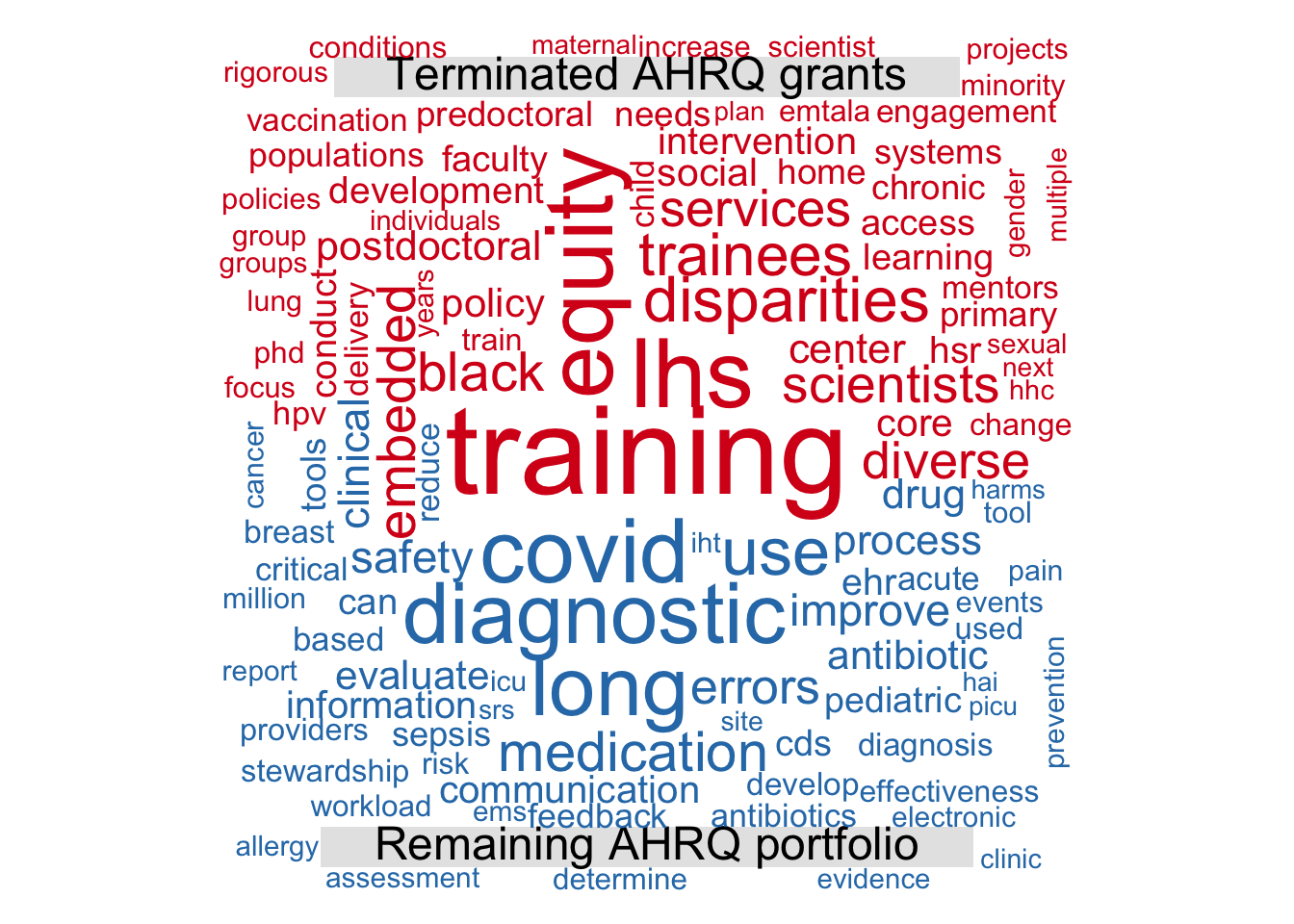
A comparison cloud yields more insights into what grants are being terminated. In the figure below, the word size is proportional to how much more that word appears in terminated grants (red) than the remainder of the AHRQ portfolio (blue). From this we can see that health equity and disparities research has been disproportionately affected, as have grants that focused on training a new generation of health practitioners. AHRQ’s portfolio of Long COVID, anti-microbial resistance, and electronic health records-related research was less affected.
We quantified this relationship more precisely5: for every word appearing in at least 5 AHRQ grants, we counted how many terminated and remaining grants contain it, and what share of all grants containing it were terminated. The results, in the table below, are striking. “Equity” is the standout — it appears in 75 terminated grants and just 13 remaining grants, meaning 85% of all AHRQ grants mentioning “equity” were terminated. Related DEI language — “disparities,” “diverse,” “equitable,” “inequities” — shows similarly high termination rates, echoing the comparison cloud above. Words tied to training and career development — “training,” “scientists,” “career,” “faculty,” “mentors” — are also disproportionately common in terminated grants, consistent with how many of the terminated awards are K- and T32-series training and career-development grants rather than standard research projects.
| Words most disproportionately common in terminated AHRQ grants | |||
| Sorted by percentage-point gap between termination rates | |||
| Term | Terminated grants | Remaining grants | % with word terminated |
|---|---|---|---|
| equity | 75 | 13 | 85.2% |
| disparities | 63 | 23 | 73.3% |
| training | 65 | 28 | 69.9% |
| diverse | 60 | 28 | 68.2% |
| scientists | 28 | 4 | 87.5% |
| train | 27 | 3 | 90.0% |
| career | 35 | 12 | 74.5% |
| equitable | 31 | 9 | 77.5% |
| rigorous | 33 | 12 | 73.3% |
| faculty | 23 | 1 | 95.8% |
| access | 58 | 40 | 59.2% |
| engagement | 38 | 18 | 67.9% |
| group | 38 | 18 | 67.9% |
| skills | 36 | 16 | 69.2% |
| social | 44 | 25 | 63.8% |
This week’s AHRQ terminations have some new legal language, but the substance of the news is more of the same: the administration repeating its patterns of malfeasance and mismanagement, disdain for Congress’s authority, and contempt for research that makes American health care more effective and equitable.
Footnotes
See our interactive funding curves for AHRQ for the live, continuously updated version of this comparison across fiscal years.↩︎
The Agency for Healthcare Research and Quality (AHRQ) Budget: Fact Sheet, Congressional Research Service Report R44136 (Table 1).↩︎
We classified each grant by matching curated keyword lists — the topic labels and synonyms — against its title, abstract, and public-health-relevance statement. This is a coarse proxy and grants frequently match more than one topic. 5 terminated grants matched none of our topic keywords, mostly general training programs (e.g., institutional T32s) or infrastructure/survey grants (e.g., the CAHPS patient-experience survey program) without a specific disease focus.↩︎
Public Law 106-129, Healthcare Research and Quality Act of 1999, govinfo.gov (official U.S. Government Publishing Office text).↩︎
For each word appearing in the title, abstract, or public-health-relevance statement of at least 5 AHRQ grants — after removing common English stopwords and generic grant-writing boilerplate like “research,” “program,” and “support” — we compare the share of terminated grants containing it to the share of the remaining portfolio containing it. This is a simple description, not a model: it doesn’t try to isolate independent effects among correlated words (e.g., “equity” and “disparities” often appear together), so overlapping terms should be read as reinforcing signals rather than separate, independent causes.↩︎