At Grant Witness, we have reported on the crisis in science funding at the National Institutes of Health by tracking grant terminations and the slowdown of new funding. Another aspect of the crisis is the increasing number of grants that are not being renewed on time, which we first observed a year ago and have continued to grow, leaving researchers in limbo as these funding delays disrupt biomedical research.
Most projects funded by NIH for more than one year are renewed each year. NIH approves projects for multiple years, and each year’s funding is released as a “non-competing continuation” following the submission of standard progress reports. Some delays in this process are inevitable, or are due to real issues or slow management by the researchers themselves. NIH processes about 50,000 renewals each year. Before 2025, less than 1,000 were renewed more than 60 days after the end of their previous budget period.
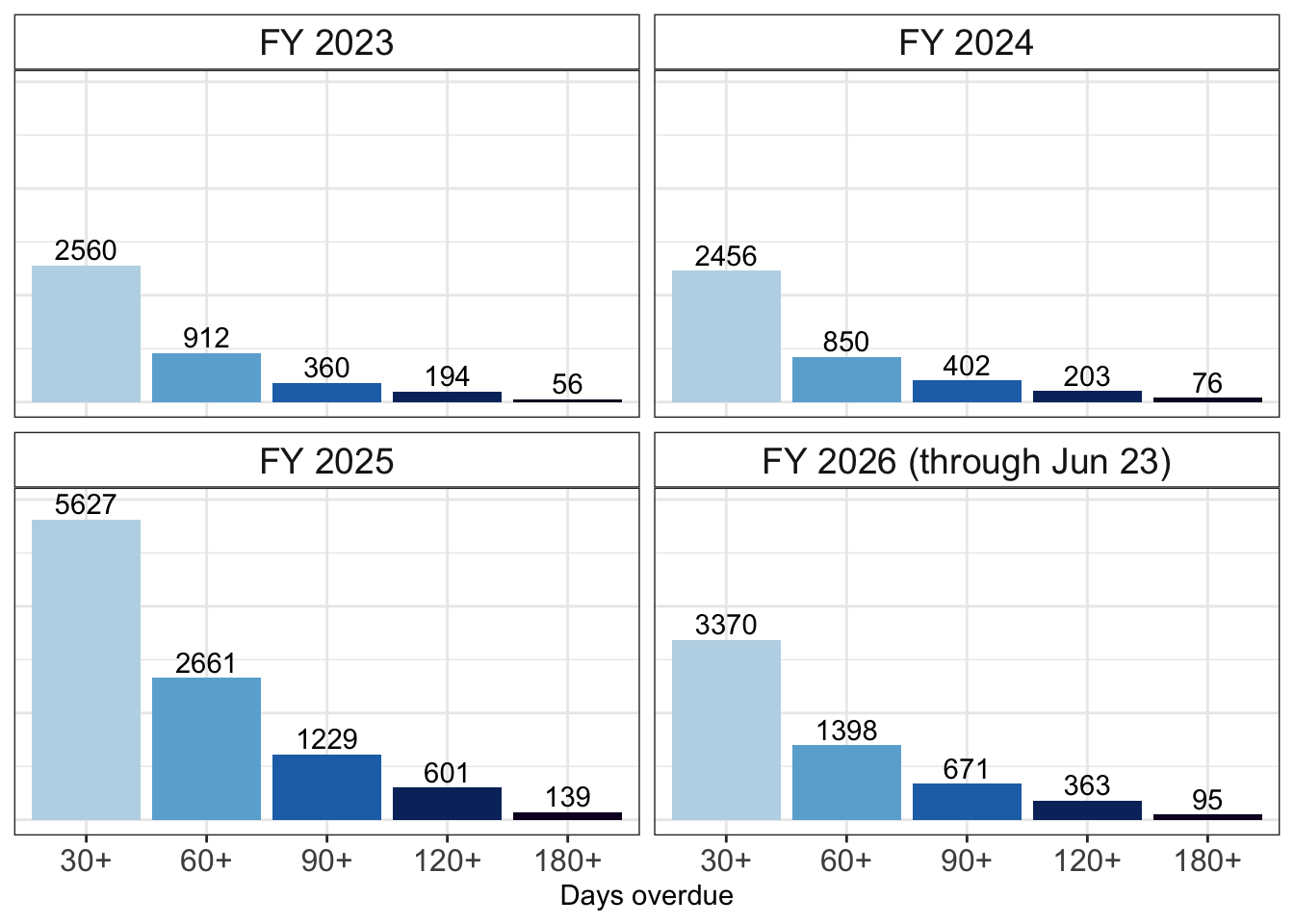
Now there is a massive slowdown in renewals across NIH. 3,672 projects faced gaps of 60 days or more since Jan 20, 2025.1 407 are currently waiting for renewal more than 60 days after the end of their previous budget period. Some have been waiting much longer.
NIH only kept 912 awards waiting more than 60 days in FY 2023. Last year the number was 2.9 times as many. If 2026 continues at its current pace there will be 3.2 times a many. By any measure, more researchers and projects are facing limbo and uncertainty than before the Trump administration (Figure 1).
These delays are only the latest disruption and uncertainty for many NIH-funded researchers. Among those currently waiting for renewal are 24 whose grants were previously terminated and restored, or were part of the institutional funding freezes in 2025. Last year, 39 grants were ultimately terminated rather than renewed after waiting long periods to learn their fate.
Unlike the clear targeting of topics such as health equity for termination, and the halting of payments to specific institutions, we have so far identified no clear pattern in the type of grant or recipient facing these delays and gaps between funding years. Elizabeth Ginexi has detailed the new layers and political review put in place to scrutinize all grants, including renewals. Whether or not a grant runs afoul of the administration’s ideological tests, the additional screening processes can slow it down well past the point of disruption. The loss of over 20% of NIH staff surely is also contributing.
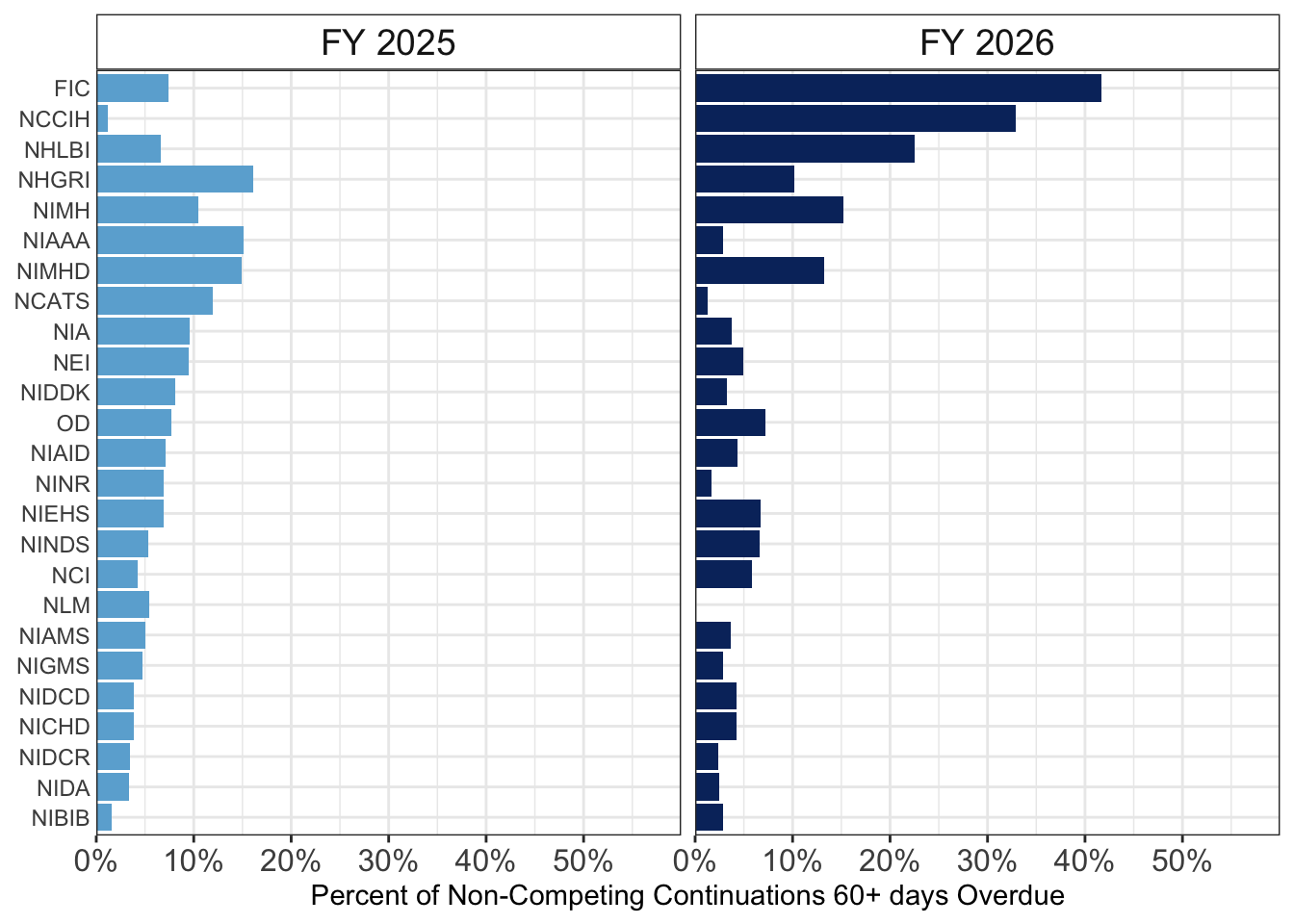
There are considerable differences across NIH institutes. Before 2025, the typical institute had 2% of its renewals delayed by 60 days or more, and the worst had 6%. Last year, over 15% of renewals from the National Institues on Alcohol Abuse and Alcoholism (NIAAA), Minority Health and Health Disparities (NIMHD), and Genome Research (NHGRI) were that late. So far this year, the worst offenders are the Fogarty International Center (FIC, 42%), the Center for Complementary and Integrative Health (NCCIH, 33%), and the Heart, Blood, and Lung institute (NHLBI, 23%) (Figure 2).
NIH’s delays pale in comparison to those of the Agency for Healthcare Research and Quality, which has had its staff gutted and has not funded any new awards this year. Only 15 AHRQ grant renewals have been issued this fiscal year, leaving 145 stuck waiting for renewals that may never come, in an agency that has typically only issued about 500 grants, new or renewals, per year.
As always, we are only able to keep on top of these developments due to the vigilance of researchers. If your grant has been terminated, suspended, frozen, delayed, or otherwise disrupted, please report! You will find reporting forms for many agencies under “Submit” at the top of the page.
Footnotes
We identify overdue awards as those that have with budget end date more than 60 days in the past but with a project end date in the future and no termination or subsequent renewal in the NIH RePORTER database. We exclude student fellowship grants (“F” series). Many of these end early when students graduate or recipients change institutions, and those are indistinguishable from overdue renewals in public data. Nonetheless, these delays impact students and trainees as well. We also exclude supplements and subprojects.↩︎